
Dynamic Mobilisation Exercises (DMEs), Carrot Stretches, and other static (standing) therapeutic trunk exercises - you’ve probably seen them on your social media feed and your physio has likely recommended them as part of your horse’s treatment and/or maintenance plan! These exercises are promoted as an effective way to activate your horse’s “core” muscles and improve dynamic core stability. But what evidence do we have to support these claims?
What Are DMEs?
DMEs are achieved when the horse actively moves their head and neck into different positions to elicit spinal flexion and lateral bending, typically using a carrot or treat as motivation. Hence DMEs are commonly called “carrot stretches”, although these exercises don’t always comply with the true definition of a “stretch”… but I’m being pedantic! Common DMEs include bringing the chin towards the chest, between the front legs, or laterally towards the shoulder, girth or hip.
Other exercises like lateral tail pulls and pelvic rounding are commonly classed as DMEs but are more appropriately called therapeutic trunk exercises (TTEs). This is because TTEs they rely on the application of external/manual pressure at specific anatomical locations, rather than reliance on active, self-guided range of motion (ROM), as per DMEs. Examples of DMEs and TTEs are illustrated below (Figure 1).
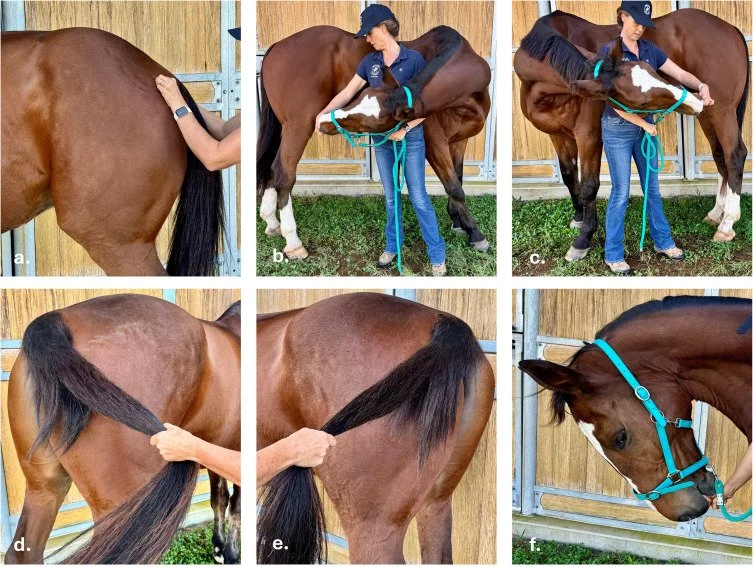
Figure 1. Common dynamic mobilization exercises (DME) and therapeutic trunk exercises (TTE). a) Caudal pelvic rounding, b) DME to the right hip c) DME to the left hip, d) Lateral tail pulls to the right, e) Lateral tail pulls to the left, f) DME chin-to-chest. Image from: Harrison et al. (2026).
What does the research tell us?
DMEs gained popularity through the work of Prof. Hilary Clayton and Dr. Narelle Stubbs, who describe these exercises in their book, “Activate Your Horse’s Core” (2008), and in research that evaluated their effects on the multifidus muscle – an important deep spinal stabiliser. In addition, Stubbs et al. (2011) used ultrasound to measure the cross sectional area (CSA) and symmetry of the multifidus in 8 horses at the beginning and end of a 3-month period, where horses performed DMEs 5 days/week. The horses were not ridden during this time and repeated the following DMEs 5x per exercise session, holding each position for 5 seconds:
· Chin-to-chest · Chin-to-girth
· Chin-between-carpi · Chin-to-flank
· Chin-between-fetlocks · Chin-to-tarsus
· Cervical (neck) extension
After 3 months, ultrasound scans revealed that multifidus CSA had significantly increased across all measured spinal levels (T10, T12, T14, T16, T18, L5) and was more symmetrical between left and right sides. This important study demonstrated that DMEs result in multifidus hypertrophy (increased muscle size), which provides evidence for activation and strengthening of this muscle that is responsible for spinal stabilization.
Other studies have since supported this in ridden (de Oliveira et al., 2015, Tabor, 2015) and unridden horses (Lucas et al., 2022) where the same DME routine from Stubbs et al. (2011) resulted in significant increases in multifidus CSA. Interestingly, these studies indicate that employing this DME regimen 3x per week for 6 weeks is sufficient to stimulate significant multifidus hypertrophy (de Oliveira et al., 2015, Tabor et al., 2015) – so you may not have to dedicate as much time to get the same beneficial effect, especially if your horse is being exercised!
“What superficial muscles are activated during these exercises?”
Recently, I collaborated with Lynne Harrison, an ACPAT physiotherapist completing her PhD at the University of Queensland to answer this question. We used surface EMG to measure epaxial (longissimus dorsi) and hypaxial (rectus abdominus, external abdominal oblique) muscle activity during selected DMEs and TTEs (see Figure 1). We observed significant increases in muscle activity across all studied exercises, but the greatest increases occurred during the chin-to-hip DME, particularly in muscles ipsilateral (same side) to the direction of the exercise (i.e. right-side muscle during DME to the right hip). The lumbar region of the long back muscle (longissimus dorsi) also exhibited comparable increases in activity during pelvic rounding. These findings generally agree with another study by Coll et al. (2023) who reported increased ipsilateral rectus abdominus activity during chin-to-hip and minimal changes in activation during chin-to-chest DMEs. In addition, Elósegui et al. (2024) investigated hindlimb muscle activity during six therapeutic exercises, including pelvic lifts, tail traction and weight-shifting exercises. Again, they found that different exercises selectively recruited specific muscles, with pelvic rounding producing particularly high activity in the gluteus medius, biceps femoris and gracilis. Thus, pelvic rounding could be acting as a lumbopelvic stabilization and mobilization exercise, rather than as a purely hypaxial strengthening activity (Harrison et al., 2026).
Together, these findings reinforce an important message: just because an exercise is described as a 'core exercise' doesn't mean it activates core muscles equally. Selecting the right exercise depends on which muscles we want to recruit and what we are trying to achieve. This is where research can help us deliver evidence-based practice as veterinary physiotherapists!
But we still have a lot to learn …
We still do not know how DMEs and TTEs affect muscle activation within the context of movement, as no studies have simultaneously measured muscle activity (using sEMG) and kinematics. This is something that we are currently addressing through new research evaluating the effect of commonly prescribed physiotherapeutic exercises on movement and muscle activity (see Reel on my social media). Further, research has only been conducted on healthy horses, so further research is required to understand the effect of these exercises on clinical populations (e.g. horses with back pain). Longitudinal studies are also required to understand whether DMEs and TTEs result in sustained functional and anatomical muscle adaptations.
So, are DMEs and TTEs worth doing? Yes, but exercise selection matters!
Current evidence supports DMEs and TTEs for the targeted activation of selected epaxial (longissimus dorsi, multifidus), hypaxial (rectus abdominus, external abdominal oblique) and hindlimb (gluteal, biceps femoris, gracilis), particularly chin-to-hip and pelvic rounding. However, understanding which exercises activate which muscles is essential for developing targeted, evidence-based exercise programmes.
References:
Coll, J.A., Blake, S. and de Godoy, R.F., 2023. Surface electromyography (sEMG) of equine core muscles and kinematics of lumbo-sacral joint during core strengthening exercises. Journal of Equine Rehabilitation, 1, p.100002.
de Oliveira, K., Soutello, R.V., da Fonseca, R., Costa, C., Meirelles, P.R.D.L., Fachiolli, D.F. and Clayton, H.M., 2015. Gymnastic training and dynamic mobilization exercises improve stride quality and increase epaxial muscle size in therapy horses. Journal of Equine Veterinary Science, 35(11-12), pp.888-893.
Elósegui, M., Cediel, R., Goyaga-Elizalde, J. and Hernández-Fernández, T., 2024. Evaluation of the electromyography activity of hindlimb muscles during core exercises in horses. Journal of Equine Rehabilitation, 2, p.100013.
Harrison, L.M., George, L.S., Goff, L.M., Nardese, G., Barnes, T., Ahern, B. and Sole-Guitart, A., 2026. The effect of dynamic mobilization exercises and therapeutic trunk exercises on superficial epaxial and hypaxial muscle activity in horses. Journal of Equine Veterinary Science, p.105940.
Lucas, R.G., Rodríguez-Hurtado, I., Álvarez, C.T. and Ortiz, G., 2022. Effectiveness of neuromuscular electrical stimulation and dynamic mobilization exercises on equine multifidus muscle cross-sectional area. Journal of Equine Veterinary Science, 113, p.103934.
Stubbs NC, Clayton HM. 2008. Activate Your Horse‘s Core: Unmounted Exercises for Dynamic Mobility, Strength, and Balance. Mason, MI: Sport Horse Publications.
Stubbs, N.C., Kaiser, L.J., Hauptman, J. and Clayton, H.M., 2011. Dynamic mobilisation exercises increase cross sectional area of musculus multifidus. Equine veterinary journal, 43(5), pp.522-529.
Tabor, G., 2015. The effect of dynamic mobilisation exercises on the equine multifidus muscle and thoracic profile. [MSc Thesis]. Plymouth, UK: Plymouth University.
Further Reading:
Clayton, H.M., 2012. Equine back pain reviewed from a motor control perspective. Comparative exercise physiology, 8(3-4), pp.145-152.
Clayton, H.M., 2016. Core training and rehabilitation in horses. Veterinary Clinics: Equine Practice, 32(1), pp.49-71.
Clayton, H.M., Kaiser, L.J., Lavagnino, M. and Stubbs, N.C., 2010. Dynamic mobilisations in cervical flexion: Effects on intervertebral angulations. Equine Veterinary Journal, 42, pp.688-694.
Harrison, L.M., Sole-Guitart, A., Ahern, B. and Goff, L.M., 2025. Functional anatomy of the equine thoracolumbar spine related to equine back rehabilitation. Journal of Equine Rehabilitation, 3, p.100027.