
New research sheds light on the effect of water treadmill exercise on equine muscle function.
St. George, L., Nankervis, K., Walker, V., Maddock, C., Robinson, A., Sinclair, J. and Hobbs, S.J., 2025. A Feasibility Study to Determine Whether Neuromuscular Adaptations to Equine Water Treadmill Exercise Can Be Detected Using Synchronous Surface Electromyography and Kinematic Data. Animals, 15(21), p.3189. https://doi.org/10.3390/ani15213189
The use of water treadmills within equine rehabilitation and training programs is becoming more and more common! You might have heard claims that this type of exercise can improve a horse’s core and hindlimb muscle “tone” and “strength” through altered movement patterns that target their activation. Indeed, a growing evidence base supports the idea that horse’s adapt their movement during water treadmill exercise (see Nankervis et al., 2017 for an overview). There are also a few studies that have demonstrated changes in muscle morphology (e.g. hypertrophy) following water treadmill exercise, measured using ultrasound or visual (subjective) assessment (Van de Winkel et al., 2016; de Meeûs d’Argenteuil et al., 2021; Tranquille et al., 2025). However, there were no scientific studies to support the assumed changes in muscle activation that occur when a horse moves through water! So, there is limited evidence that directly supports the reported benefits of water treadmill exercise on equine muscle function. This knowledge is, of course, essential for developing evidence-based training and rehabilitation programs!
I discussed my desire to understand the relationship between the adaptive movement and (assumed) muscle activation patterns that occur during water treadmill exercise with Dr. Kathryn Nankervis – a world-renowned expert in equine hydrotherapy and rehabilitation and Director of Hartpury University’s Equine Therapy Centre. Together, we decided to conduct novel equine biomechanics research to tackle this challenge! The research team consisted of Dr. Vicki Walker and Chirsty Maddock (Hartpury University), Dr. Amy Robinson (Delsys Europe), and Prof. Sarah Jane Hobbs (University of Lancashire).
A pilot study is small-scale “trial run” of an experiment that allows the researcher to identify any logistical problems and make changes before running the full-scale experiment. Since no one had previously quantified synchronous movement and muscle activity during water treadmill exercise using optical motion capture and surface electromyography (sEMG) technologies, we decided that a pilot study was necessary to determine whether this was feasible. If nothing else, to ensure that we wouldn’t damage expensive sensors and equipment around the water!
We recruited one Warmblood horse that lived at Hartpury University for our pilot study and collected sEMG data from selected epaxial/back (longissimus dorsi at L1) and hindlimb (biceps femoris, middle gluteal, tensor fascia latae) muscles, as well as 3D kinematic (movement) data from the back (thoracolumbar and lumbosacral regions) and pelvis. Data were collected and compared across four conditions:
Overground, in-hand walking on a hard runway at 1.7 m/s
Dry treadmill walking at 1.7 m/s (speed matched to overground)
Dry treadmill walking at 1.4 m/s (speed matched to water treadmill)
Water treadmill walking at 1.4 m/s (80% of overground speed)
What did we find? Most importantly, our method for collecting synchronous sEMG and OMC data was successful and feasible! We also gathered some interesting preliminary findings from this single horse, which are listed below. It is very important to note that these preliminary data are from a single horse and should therefore be considered cautiously until further research can determine whether similar adaptations are observed in a larger group of horses!
Dry and water treadmill exercise elicited significant adaptations in hindlimb and epaxial muscle activation patterns when compared to overground walking. These adaptations were most pronounced on the water treadmill - suggesting that:
Water treadmill exercise requires muscle activation patterns that differ from walking overground and on a dry treadmill.
Muscle activation during treadmill exercise may be more affected by the presence of water than belt speed.
Compared to overground walking, we observed the following statistically significant changes in the hindlimb:
Increased and prolonged activation of hip extensors (biceps femoris and middle gluteal) during stance in dry and water treadmill conditions.
Increased hip extensor activation at the end of swing phase (as the limb prepares for impact) during dry and water treadmill conditions.
Prolonged hip flexor (tensor fascia latae) activation during swing phase in water treadmill walking.
Compared to dry treadmill walking, we observed the following statistically significant changes in the back:
Increased thoracolumbar flexion, pelvic pitch (flexion) and roll, without increases in thoracolumbar lateral bending during water treadmill walking.
Increased bilateral longissimus lumborum activity during water treadmill walking – possibly to stabilise the spine against increased thoracolumbar and pelvic range of motion!
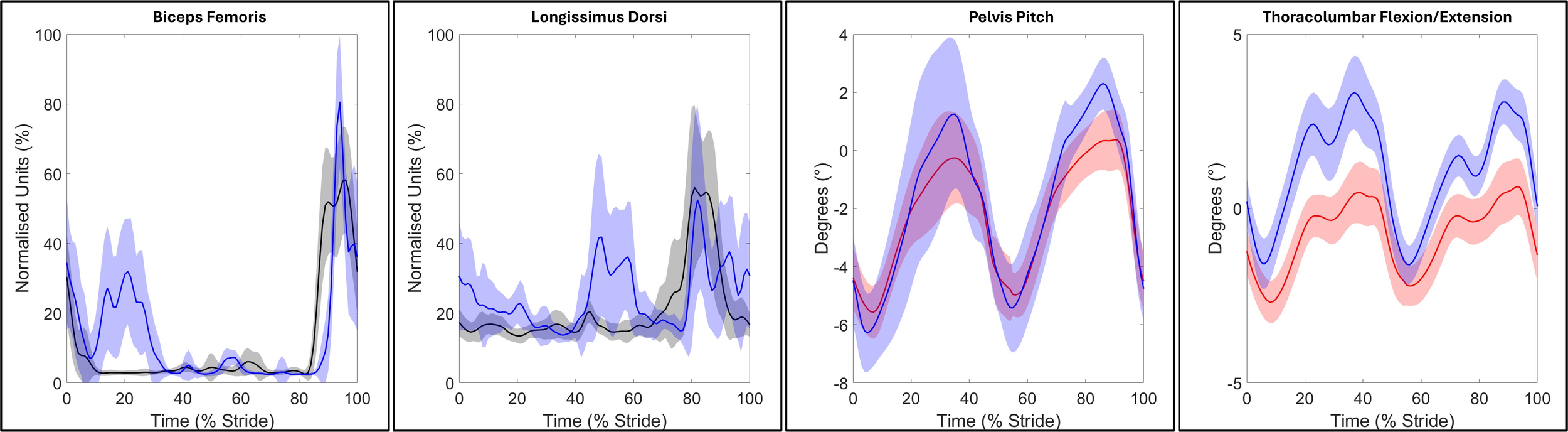
Selected sEMG and 3D kinematic data from the pilot study including: average (solid line) and standard deviation (shaded area) biceps femoris and longissimus dorsi muscle activity across walking strides during overground (black lines) and water treadmill (blue) conditions. Note the increased and prolonged activation of both muscles during water treadmill walking.
Average (solid line) and standard deviation (shaded area) pelvis pitch and thoracolumbar flexion/extension time-angle curves across walking strides during dry treadmill (red) and water treadmill (blue) conditions. Note the increased flexion angles (positive values) of the pelvis and thoracolumbar region during water treadmill walking.
A more extensive description and illustration of our findings and their interpretation can be found in the peer reviewed article:
St. George, L., Nankervis, K., Walker, V., Maddock, C., Robinson, A., Sinclair, J. and Hobbs, S.J., 2025. A Feasibility Study to Determine Whether Neuromuscular Adaptations to Equine Water Treadmill Exercise Can Be Detected Using Synchronous Surface Electromyography and Kinematic Data. Animals, 15(21), p.3189. https://doi.org/10.3390/ani15213189
We need to do more work to build on these preliminary findings from one horse. Thankfully, we have recently been awarded research funding from the Hong Kong Jockey Club’s Equine Welfare Research Foundation, which will enable us to continue our research in this area. Watch this space for further updates!
Cited References:
de Meeûs d’Argenteuil, C., Boshuizen, B., Oosterlinck, M., van de Winkel, D., De Spiegelaere, W., de Bruijn, C.M., Goethals, K., Vanderperren, K. and Delesalle, C.J.G., 2021. Flexibility of equine bioenergetics and muscle plasticity in response to different types of training: An integrative approach, questioning existing paradigms. PLoS One, 16(4), p.e0249922. https://doi.org/10.1371/journal.pone.0249922
Nankervis, K.J., Launder, E.J. and Murray, R.C., 2017. The use of treadmills within the rehabilitation of horses. Journal of Equine Veterinary Science, 53, pp.108-115. https://doi.org/10.1016/j.jevs.2017.01.010
Tranquille, C., Nankervis, K., Tacey, J., Hopkins, E., Deckers, I., Walker, V., MacKechnie-Guire, R., Newton, R. and Murray, R., 2025. Does Muscle Development of Sport Horses Using Water Treadmill Exercise as Part of a Long-Term Training Programme Differ from That of Horses Not Using Water Treadmill Exercise?. Animals, 15(16), p.2426. https://doi.org/10.3390/ani15162426
Van de Winkel, D., de Bruijn, M., Touwen, N., Duchateau, L., Goethals, K., Oosterlinck, M., Pille, F., Vanderperren, K. and Delesalle, C., 2016. Morphological changes in 15 skeletal muscles of horses after 8 weeks of aquatraining. Equine Veterinary Journal, 48(S49), pp. 30. https://doi.org/10.1111/evj.58_12595